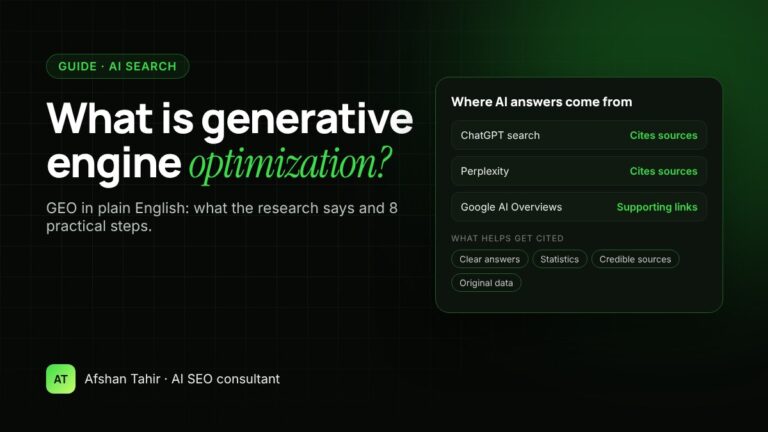
Generative engine optimization (GEO) means making your content easy for AI tools like ChatGPT, Perplexity and Google’s AI Overviews to find, trust and cite in their answers. It builds on SEO rather than replacing it: the same well-structured, credible pages that rank on Google are the ones AI answers usually draw from.
I help businesses with this as part of my AI SEO services. This guide explains GEO in plain English, what the research actually says, and the practical steps I use.
What is generative engine optimization?
A “generative engine” is a search tool that writes an answer instead of just listing links. ChatGPT search, Perplexity, Microsoft Copilot and Google’s AI Overviews and AI Mode all work this way. They read several web pages, combine what they find and often cite the sources they used.
GEO is the work of making your pages one of those sources. The term comes from a 2023 research paper by researchers at Princeton and other institutions, later presented at the KDD 2024 conference (Aggarwal et al.).
GEO vs AEO vs SEO
These three terms overlap, and you’ll see them used loosely. This is how I separate them:
| SEO | AEO (answer engine optimization) | GEO (generative engine optimization) | |
|---|---|---|---|
| Goal | Rank pages in search results | Be the direct answer to a question | Be cited or mentioned in AI-written answers |
| Where it shows | Google and Bing result lists | Featured snippets, voice assistants, “People also ask” | ChatGPT, Perplexity, Copilot, Google AI Overviews and AI Mode |
| Main levers | Relevance, technical health, links, content quality | Clear question-and-answer content, concise definitions | Clear facts, credible sources, original data, a consistent brand identity across the web |
| How it’s measured | Rankings, impressions, clicks | Snippet ownership, impressions | Citations and mentions in AI answers, referral visits from AI tools |
In practice, one good strategy covers all three. You don’t need three separate projects.
What the research says
The original GEO paper tested ways to change web content and measured how often it appeared in AI-generated answers. Its main findings:
- Visibility can improve by up to 40% in generative engine answers with the right changes (arXiv).
- Citations, quotations from relevant sources and statistics helped most, according to a review of the paper.
- Results varied by topic. The authors note that what works in one subject area may not work in another.
A note of caution: this was a research benchmark, not a promise for your website. AI tools change often, and no one outside these companies knows exactly how they choose sources.
What Google says about AI Overviews
Google’s own guidance is clear: “There are no additional requirements to appear in AI Overviews or AI Mode, nor other special optimizations necessary” (Google Search Central). A page can be shown as a supporting link if it is indexed and eligible to appear in Search with a snippet.
Google also says you don’t need special AI text files or new schema markup for this. The best practices it lists are standard SEO: allow crawling, use internal links, keep important content in text, make structured data match the visible page, and keep your Business Profile up to date.
So if someone sells you a “secret AI Overviews hack”, be careful. For Google, GEO mostly means doing SEO well.
8 practical GEO steps
- Make sure AI tools can reach your site. Check robots.txt and any firewall or CDN settings. If a crawler is blocked, your pages can’t be used. Decide deliberately which AI crawlers you allow.
- Answer first, then explain. Open each key page and section with a direct one- or two-sentence answer, then the detail. AI tools look for clear, self-contained statements they can quote.
- Be clear about who you are. Use the same business name, description, services and location on your website, Google Business Profile, LinkedIn and directory listings. Add Organization or Person schema that matches what’s on the page.
- Add facts, numbers and sources. Back up claims with statistics, dates and links to credible sources, the same signals the GEO research found most helpful. Never invent numbers to look credible.
- Publish something only you can say. Original case studies, your own data, real examples and expert opinions give AI tools a reason to cite you instead of a generic page. My website rebuild case study is an example.
- Cover the full topic, not one keyword. Build a service page plus supporting articles that answer the related questions buyers ask, all linked together.
- Get mentioned on trusted sites. AI answers often draw on reviews, industry directories, forums and news articles. Genuine reviews, PR and expert contributions build those mentions.
- Keep the technical basics solid. Fast pages, clean indexing, working internal links and structured data that matches the visible text help both Google and AI tools understand your site.
How to measure AI visibility
AI visibility is harder to measure than rankings, so use several signals together:
- Google Search Console: traffic from AI Overviews and AI Mode is counted in the normal Performance report under the “Web” search type (Google).
- Google Analytics 4: look for referral visits from AI tools such as chatgpt.com, perplexity.ai and copilot.microsoft.com.
- A fixed question list: each month, ask ChatGPT, Perplexity and Google the same 10–20 questions your buyers ask, and record whether your business is mentioned or cited.
- Leads: add “How did you hear about us?” to your contact form. Some clients will tell you an AI tool recommended you.
What GEO can’t promise
- No one can guarantee your business will appear in ChatGPT or Google AI Overviews.
- AI answers change from one question to the next, so a mention one day may not show the next.
- GEO doesn’t replace SEO. If Google can’t find and trust your pages, AI tools that rely on search results probably won’t either.
Anyone who promises guaranteed AI rankings is selling something that doesn’t exist.
Where to start
Start with your most important service page. Rewrite its opening so it answers the main buyer question in two sentences, add proof such as numbers, reviews and a case study, and check that your business details match across the web. Then measure with a fixed question list for a few months.
If you’d like help, my AI SEO services cover the full process: an AI visibility check, fixes to your key pages, content that builds topical authority and monthly tracking. If you also want AI to take repetitive marketing work off your plate, see my AI automation services.
Frequently asked questions
What does GEO stand for in SEO?
GEO stands for generative engine optimization: improving your content so AI tools such as ChatGPT, Perplexity and Google AI Overviews cite or mention it in their answers.
Is GEO different from SEO?
GEO builds on SEO. SEO aims to rank pages in search results, while GEO aims to be cited in AI-written answers. Most of the work overlaps: clear content, credible sources, technical health and a consistent brand identity.
Do I need special markup or an AI text file for AI Overviews?
No. Google says there are no additional requirements or special optimizations needed to appear in AI Overviews or AI Mode. Pages need to be indexed and eligible to show a snippet.
How long does GEO take to work?
It depends on your site’s current authority and how often AI tools refresh their sources. Track progress monthly with a fixed list of questions rather than expecting quick results.
Can you guarantee my business appears in ChatGPT?
No one can guarantee that. GEO improves your chances by making your content clearer, more credible and easier to cite.
Want to know how visible your business is in AI search? Book a free 30-minute call and I’ll check what ChatGPT and Google say about your business today.