 By
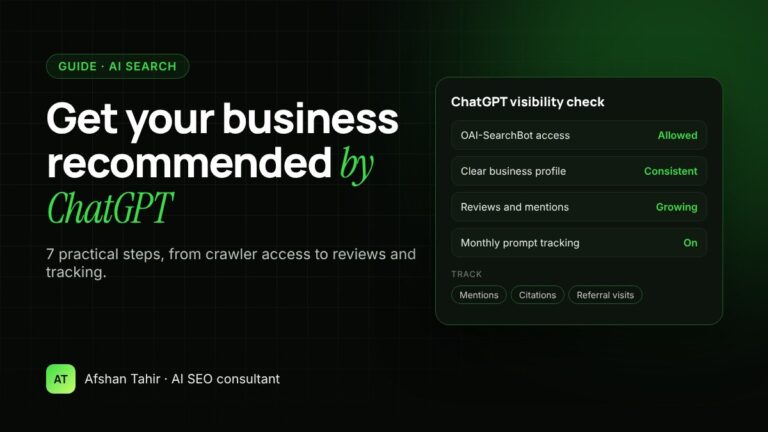
To get your business recommended by ChatGPT, make sure ChatGPT’s search crawler can reach your site, rank well in regular search, describe your business clearly and consistently everywhere, and earn genuine reviews and mentions on trusted websites. No one can guarantee a recommendation, but these steps give ChatGPT the information it needs to choose you.
This is the core of my AI SEO services. Here is how I approach it, step by step.
How ChatGPT finds businesses to recommend
ChatGPT answers in two ways:
- From what it already learned. Its training includes a large amount of public web content, so well-known businesses may be mentioned from memory.
- From a live web search. For questions like “best accountant near me” or “top e-commerce SEO agencies”, ChatGPT often searches the web and shows its sources. OpenAI says search draws on third-party search providers and content partners (OpenAI).
For most small businesses, the live search route is the realistic one. Your website, reviews and mentions need to be findable when ChatGPT looks.
1. Let ChatGPT’s search crawler in
OpenAI uses a crawler called OAI-SearchBot to show websites in ChatGPT search. OpenAI recommends allowing it in robots.txt, and says sites that block it won’t appear in ChatGPT search answers (OpenAI crawler documentation).
A separate crawler, GPTBot, collects content for training. The settings are independent: you can allow OAI-SearchBot for search while blocking GPTBot from training.
Check three things:
- Your robots.txt doesn’t block OAI-SearchBot (or all bots).
- Your firewall, security plugin or CDN isn’t blocking it either. These sometimes block unfamiliar bots by default.
- Your important content is in normal text on the page, not only in images or PDFs.
2. Be easy to find in regular search engines
Because ChatGPT search relies on search providers, pages that rank well in regular search are more likely to be found. That means the basics still matter: a fast site, clean indexing, clear page titles and service pages that match what people search for.
Make sure your site is verified in Google Search Console and in Bing Webmaster Tools, with your sitemap submitted to both. Bing also powers Microsoft Copilot’s web results, so it’s worth covering both.
3. Say clearly who you are, what you do and where
AI tools recommend businesses they can describe with confidence. Make that easy:
- Homepage: one clear sentence on what you do, for whom and where. For example, “Family dental clinic in Austin, Texas, offering check-ups, implants and emergency care.”
- About page: your experience, team and credentials in plain words.
- Consistency: use the same business name, address, phone, services and description on your website, Google Business Profile, LinkedIn and directories.
- Structured data: add Organization or LocalBusiness schema that matches what’s visible on the page.
4. Create pages that match how people ask
People ask ChatGPT full questions, not keywords: “Who is the best SEO consultant for a jewelry store?” or “Which plumber in Leeds offers same-day repairs?” Your site should answer those questions directly:
- A clear page for each main service, with who it’s for, what’s included, the process and typical prices or price ranges.
- Pages for the industries or locations you genuinely serve.
- FAQs that answer real buyer questions in two or three sentences each.
- Honest comparisons, such as “when to choose us, and when another option fits better”. Balanced information is more useful to quote.
5. Earn reviews and mentions on trusted sites
When ChatGPT searches, it often reads review sites, directories, industry lists, news articles and forums, not just your own website. What others say about you counts.
- Reviews: ask happy customers for honest Google reviews and reviews on the platforms that matter in your industry.
- Directories: list your business on reputable, relevant directories with complete, matching details.
- Expert mentions: contribute quotes, guest articles or podcast interviews in your industry.
- Communities: answer questions helpfully where your customers ask them, without spamming links.
Never buy fake reviews. Beyond the ethical and legal risks, review platforms remove them, and they can damage your reputation in exactly the places AI tools read.
6. Show proof
Recommendations lean towards businesses with visible evidence: case studies with real numbers, named clients (with permission), awards, certifications and clear results. If you have a strong project, write it up. My website rebuild case study is one example.
7. Track whether ChatGPT mentions you
Set up a simple monthly check:
| What to check | How |
|---|---|
| Are you mentioned? | Ask ChatGPT the same 10–20 buyer questions each month, such as “best [service] in [city]” and “who can help with [problem]”, and record the results |
| Who appears instead? | Note the competitors and sources ChatGPT cites. They show you what it trusts. |
| Visits from ChatGPT | In Google Analytics 4, look for referral traffic from chatgpt.com |
| Leads | Add “How did you hear about us?” to your contact form |
Answers can change from one day to the next, so look for trends over several months rather than reacting to a single answer.
What doesn’t work
- Guaranteed “ChatGPT rankings”. No one controls what ChatGPT recommends.
- Stuffing pages with phrases like “best company in the world”. AI tools look for evidence, not claims.
- Fake reviews or bought mentions. They’re risky and easy to spot.
- Special “AI files” as a shortcut. Clear content, crawl access and real reputation matter far more.
For the bigger picture of optimizing for AI answers, read my guide to generative engine optimization (GEO). If you serve a local area, my local SEO services cover the reviews, profile and directory work that local recommendations rely on.
Frequently asked questions
How does ChatGPT decide which businesses to recommend?
OpenAI doesn’t publish an exact method. For live answers, ChatGPT searches the web using third-party search providers and cites sources, so businesses with crawlable websites, strong search visibility, clear information and good reviews and mentions are more likely to appear.
Can I pay to be recommended by ChatGPT?
Not in the answers themselves. OpenAI has started testing ads in ChatGPT for some US users, but says they are labelled as sponsored, shown separately, and “do not influence the answers ChatGPT gives you” (eWeek). Be wary of anyone who promises guaranteed ChatGPT rankings.
Should I block GPTBot?
That’s your choice. Blocking GPTBot stops your content being used for training, but it doesn’t remove you from ChatGPT search. Search visibility is controlled by OAI-SearchBot, which OpenAI recommends allowing.
How long does it take to appear in ChatGPT answers?
It varies. Crawl access changes can take effect within about a day, according to OpenAI, but building reviews, mentions and search visibility usually takes months.
Does local SEO help with ChatGPT recommendations?
Yes. Accurate business details, a complete Google Business Profile, consistent directory listings and genuine reviews are the same signals people and AI tools use to judge local businesses.
Want to know whether ChatGPT recommends your business? Book a free 30-minute call. Before we speak, I’ll ask ChatGPT and Google five questions your customers ask, and show you whether your business comes up and who appears instead.