 By
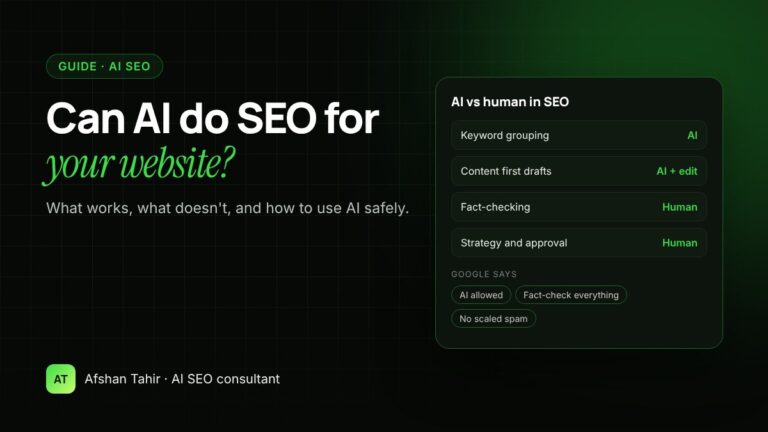
AI can do a large part of the day-to-day SEO work, such as research, first drafts, data analysis and reporting, faster than a person. But it can’t be trusted to work alone: it gets facts wrong, can’t build real reputation, and doesn’t know your business. The best results come from AI doing the heavy lifting and an experienced person making the decisions and checking the work.
I use AI in every SEO project, as part of my AI SEO services. Here’s an honest look at what works and what doesn’t.
What Google says about AI and SEO
Google doesn’t ban AI-generated content. Its guidance says generative AI “can be particularly useful when researching a topic, and to add structure to original content” (Google Search Central). But it sets clear limits:
- No mass-produced pages. Generating many pages with AI without adding value for users may break Google’s scaled content abuse policy.
- Fact-check everything. Google warns that generative models “don’t retrieve facts, but predict a likely sequence of words”, and says it is “critical to manually factcheck and review all AI-generated content”.
- Check the details too. Titles, meta descriptions, structured data and image alt text need the same review as the page text.
What AI does well in SEO
| SEO task | What AI can do | What a person still does |
|---|---|---|
| Keyword research | Group keywords, find questions, map them to pages | Choose targets based on business value and real search data |
| Content briefs and drafts | Outline, draft sections, suggest FAQs | Add experience and examples, check every fact, edit the voice |
| Technical audits | Sort crawl data, spot patterns, explain issues in plain English | Decide what to fix first and check fixes don’t break anything |
| On-page optimization | Suggest titles, descriptions, headings and internal links | Approve changes and avoid keyword cannibalization |
| Reporting | Turn Search Console and Analytics data into a summary | Check the numbers and don’t let guesses pass as causes |
| Schema markup | Write structured data code quickly | Validate it and make sure it matches the page |
For example, I describe how I automate weekly reporting in my guide to automated SEO reports with AI.
What AI can’t do (or shouldn’t do alone)
- Know your business. AI doesn’t know your margins, best customers, capacity or which services you actually want to sell more of.
- Guarantee accuracy. It can invent statistics, features and sources that sound convincing.
- Build reputation. Reviews, links and mentions on trusted sites come from real relationships and real work.
- Provide first-hand experience. Case studies, photos, results and expert opinion have to come from you.
- Take responsibility. Someone has to approve what goes live on your website.
A real example of AI mistakes in SEO work
When I rebuilt this website with Claude, AI did most of the auditing, drafting and building. My reviews still caught real problems: promises I hadn’t made, such as a “48-hour reply” guarantee, a “Most popular” label with no data behind it, a wrong guess about why a booking wasn’t tracked, and a plan with far more redirects than the site needed. I wrote up the whole process in my AI website rebuild case study.
None of these would have been caught by AI checking its own work. That’s why every AI-assisted SEO workflow needs a human review step.
The risks of “fully automated” AI SEO
- Hundreds of thin pages. Mass-generated location or keyword pages that add nothing can drag the whole site down and may break Google’s spam policies.
- Wrong information. One invented price or false claim can cost you a customer’s trust.
- Generic content. If your page says the same thing as every AI-written page, there’s no reason for Google or AI search tools to choose it.
- Broken technical changes. Automated edits to redirects, canonicals or robots.txt can remove pages from search.
How to use AI for SEO safely
- Start with strategy. Decide your goals, target customers and priority pages before using AI.
- Use AI for research and first drafts, not final answers.
- Add what only you have: examples, data, photos and opinions.
- Fact-check everything, including titles, descriptions and schema.
- Approve every live change, and keep backups.
- Measure results in Search Console and Analytics, and adjust.
Should you do AI SEO yourself or hire help?
If you have time and some SEO knowledge, AI tools can help you do more yourself, especially content and simple reporting. Hiring help makes sense when you need a clear strategy, technical fixes, or reliable workflows your team can repeat. That’s what my AI SEO services and AI automation services cover.
Frequently asked questions
Can AI do SEO for my website?
AI can handle much of the research, drafting, analysis and reporting. It still needs an experienced person to set the strategy, check facts and approve changes, because it makes mistakes and doesn’t know your business.
Does Google penalize AI-generated content?
Google doesn’t ban AI content. It does act against mass-produced pages that add no value, under its scaled content abuse policy, and it says all AI-generated content should be fact-checked and reviewed.
Will AI replace SEO experts?
AI is changing how SEO work is done and makes many tasks faster. Strategy, judgement, reputation building and accountability still need people, so the role is shifting rather than disappearing.
What are the best SEO tasks to use AI for?
Keyword grouping, content briefs, first drafts, analysing crawl and analytics data, writing schema code and turning data into reports.
Is it safe to publish AI-written blog posts?
Only after a person has checked the facts, added real experience and edited the content to be genuinely useful. Publishing large amounts of unreviewed AI content is risky.
Want AI-powered SEO with expert oversight? Book a free 30-minute call. Before we speak, I’ll ask ChatGPT and Google five questions your customers ask, and show you whether your business comes up and who appears instead.